Reading the venue note: what changed at three Premier League grounds this week
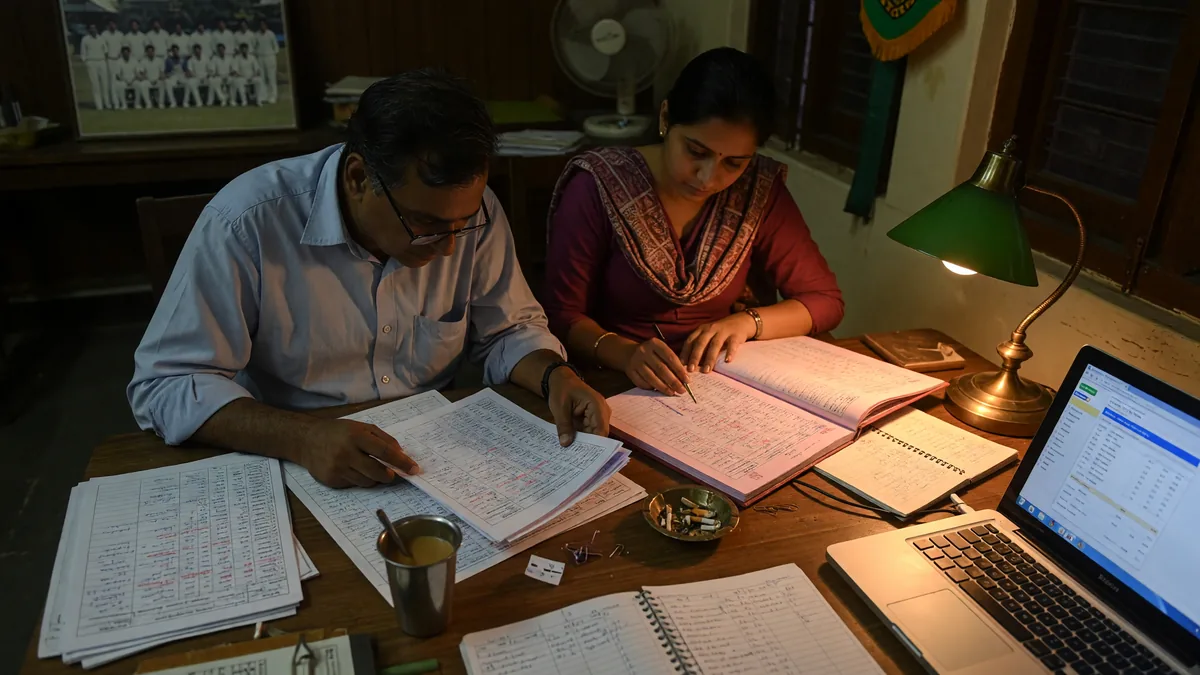
Documentary frame: the desk’s venue-note review meeting.
Three grounds, three different captaincy matrices. The desk walks through the boundary length, grass cover and dew window for the next round of fixtures and explains how each one shifts the captain pick by a category.
Ground 01
Ground A — boundary closed by two metres
The news that shifted on Friday was the boundary at Ground A, which came in two metres tighter than the published measurement after a paint refurbishment midweek. Two metres is small on a 65-metre boundary; it is large on a 55-metre boundary.
The captain-matrix implication. The powerplay six-hitter at the venue moves from a balanced pick to a strong differential. The wrist-spinner differential loses a row of points on the height-the-bat rate rather than on the powerplay boundary-rate.
The deck’s captain pick on this fixture moves to the powerplay six-hitter in the batting order. The vice-captain allocation moves to the wrist-spinner differential; the 1.5× insurance stays live if the captain’s matchup goes cold.
Ground 02
Ground B — grass cover rolled up
The news that shifted on Saturday was the grass cover at Ground B, which the head groundskeeper rolled up overnight. The deck’s pre-fall view had been a flat batting deck with two wicket-taking seamers. The post-rollup view is a different pitch: green seam, two wrist-spinners now ambient.
The captain-matrix implication. The pace-bowling all-rounder differential moves from ceiling to a sub-floor pick on the morning session. The wrist-spinner differential moves from sub-floor to a ceiling pick on the afternoon session.
The deck’s captain pick on this fixture moves to the wrist-spinner in the afternoon session, and to the seam-bowling all-rounder in the morning session. The reader who has the venue-note app open at the morning toss call has the shift locked at the captain-matrix.
Ground 03
Ground C — dew window pulled back two overs
The news that shifted on Sunday was the dew window at Ground C, which the groundskeeper pulled back two overs after a light drizzle. The standard evening-dew window starts at the 16th over; the pulled-back window starts at the 18th.
The captain-matrix implication. The wrist-spinner captain pick on this fixture moves from ceiling to a strong pick on the 18th over onwards. The pace-bowling all-rounder captain pick moves from strong pick on the 12th-15th to a balanced pick on the 18th over onwards.
The deck’s captain pick on this fixture is the wrist-spinner if the batting-side captain has the 18th-over dew window. The deck’s vice-captain pick is the pace-bowling all-rounder at the morning session.
Methodology
How the desk reads the three shifts together
The three shifts are independent in venue, but the deck reads them together as a working note on the week’s fixtures. Each shift moves one vertex of the captain matrix; the three together move the captain-matrix reading for any fixture that lands at one of the three grounds.
The pattern is small. A boundary two metres tighter shifts the powerplay six-hitter role. A grass cover rolled up shifts the wrist-spinner role. A dew window pulled back two overs shifts the captain-multiplier allocation at the toss. None of the three is a category shift; together they are a working-note update on the week’s fixtures.
The deck publishes the shift on the news desk the day after it lands, links the working note to the relevant fixture card on the predictions page, and updates the captain-matrix rule on the captain-vice-captain page within the desk’s review window.