Six practical rules for picking the captain and vice-captain, plus a worked example that walks through a real differential pick.
Captain and vice-captain matrix
Six practical rules for picking the captain and vice-captain, plus one worked example that walks through a real differential pick.

Rule 1 — Captain from your strongest role
Pick the captain from the role category the team has the most confidence in. A captain from a weaker role is an attempt to win two categories at once — usually at the cost of both.
Rule 2 — Vice-captain from a different matchup
Place the vice-captain in a different matchup from the captain. The 1.5× insurance stays live only if both captains can reasonably score; captains in the same matchup usually fail together.
Rule 3 — Skip last night's top scorer
Ownership rarely lifts ceiling the next game. Captain picks that echo last night's leaderboard read as safe and finish as crowded.
Rule 4 — Use the venue note
Boundary length, grass cover and dew window decide captain value as much as form does. A captain against a venue that suppresses their role is a ceiling cut.
Rule 5 — Lock after the toss
Probable XI is a working hypothesis. The toss call converts it into a contract. The desk locks captaincy after the toss, never before the probable XI.
Rule 6 — Skip differential captain when the contest rewards floors
Differential captains win small leagues and head-to-heads. They lose mega contests where floor plays dominate. Read the contest type before choosing between safe and differential.
Worked example
Sample fixture: Wankhede evening, dew expected from the 16th over, two all-rounders and a wrist-spinner in form. Safe captain: top-order bat on the batting side. Balanced captain: in-form all-rounder on either side. Differential captain: wrist-spinner with three wickets in the last two games. The desk would take the all-rounder as captain for a small league and the differential for a head-to-head.
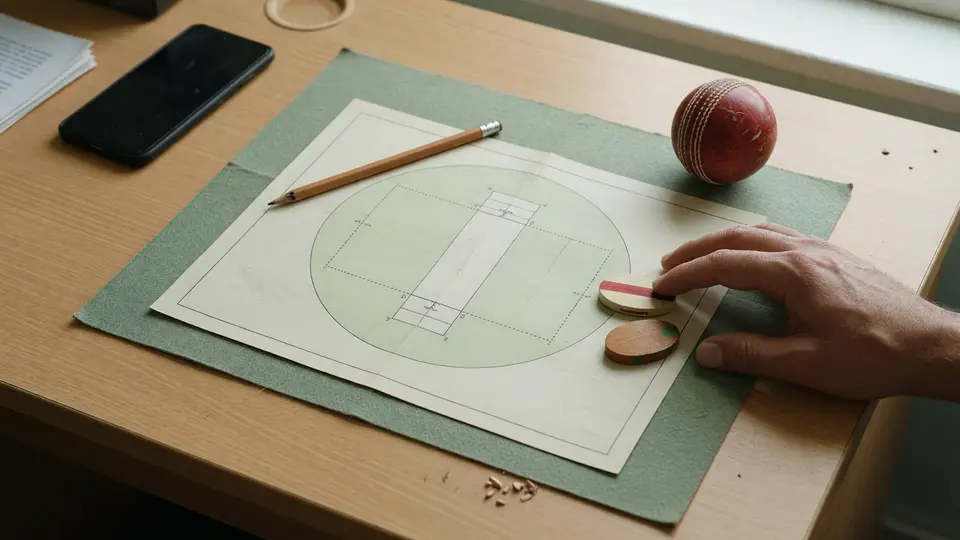
What the captain matrix actually does
The captain and vice-captain choice is the single highest-leverage decision a fantasy-cricket reader makes inside a contest window. Points earned by a captain are doubled; points earned by a vice-captain are multiplied by 1.5. In a 1000-point match, the difference between a safe captain pick and a differential captain pick can be 200-400 points — wider than the gap between two player-pool choices added together. The desk's captain matrix exists to make that decision auditable, not to predict it, and the difference between "auditable" and "predictive" is what the rest of this guide explains.
The matrix sorts players into four columns: safe captain, differential captain, safe vice-captain and differential vice-captain. A safe pick is one whose ceiling is well-known, whose ownership is high, and whose downside is bounded by role. A differential pick is one whose ceiling is plausible but not consensus, whose ownership is low, and whose downside is bounded only by the same role. The matrix does not score ceiling — it scores the consensus view of ceiling against the desk's read, and the gap between the two views is what the matrix surfaces.
Editorial independence is the line the desk holds on this page. Captain matrices from partner brands tend to lean towards safe picks that protect contest entry fees; the desk's matrix accepts that tradeoff in its own columns but does not pretend the differential column is anything other than a contest-winning lottery ticket. The reader who wants a contest-winning team accepts the lottery-ticket framing. The reader who wants a contest-protective team uses the safe columns. Both readers are welcome; the matrix is the same for both, because the matrix is the desk's read, not the reader's goal.
A reader who wants a custom read can substitute their own column for any of the four. The desk's recommendation is to keep at least one safe pick in the captain or vice-captain slot across the contest window, not because safe picks win — they often do not — but because a contest window with all-differential picks is a contest window where one bad surface read can ruin the entire entry. The safe-pick floor is a portfolio decision, not a prediction, and the matrix is structured to support that portfolio decision.

How the matrix is built each match day
The desk starts each match day with the published lineups, the published pitch report, and the published weather window. Those three inputs go into the safe column. The differential column adds the desk's read on each player's ceiling against the published ownership percentage: a player whose ceiling exceeds the consensus ceiling by more than a third is differential; a player whose ceiling matches consensus is safe. The threshold of "more than a third" is the desk's editorial call and is the call most likely to be revised in the next matrix refresh.
Ownership data is the second input. The desk uses published ownership snapshots from a small set of independent sources, not from any partner brand. Where the snapshot is missing or contradictory, the matrix marks the relevant pick as "no read" rather than guessing. The captain matrix is published with "no read" entries where applicable; readers should treat a "no read" captain cell as a smaller bet, not as a recommendation, and a "no read" vice-captain cell as a deliberate hedge rather than a wasted slot.
Venue is the third input. A dry pitch and short boundary pulls the matrix towards power hitters in the captain column; a green pitch and long boundary pulls the matrix towards bowlers in the captain column. The desk does not average those two vectors — the matrix either leans power or it leans bowling, and the reader picks the contest that matches the matrix lean. Picking the wrong contest for the matrix lean is the most common cause of a captain pick underperforming its ceiling, because a power-hitter captain on a green pitch is contest-protective at best and differential at worst.
The desk publishes the captain matrix once per contest window, with a refresh on the morning of the match day when the pitch report changes materially. A pitch-report change is "material" when the published grass cover, surface moisture, or boundary length changes by more than a third from the previous report. Smaller changes do not trigger a refresh, because a refresh on every pitch-report tick would publish more matrices than readers can compare, and the desk's priority is comparable matrices, not the most recent matrix.
Where the matrix gets contested
A matrix entry gets contested when the published ownership snapshot disagrees with the desk's read of ceiling. The contest happens on the page, not in the matrix. A reader who has seen the same fixture five times and has a strong view against the matrix differential pick should follow their view; the matrix is a starting point, not a rule. What the matrix does is make the disagreement explicit: the reader sees the matrix pick, sees the desk's reasoning, and either concurs or differs, and the difference is what the reader's contest window is actually built on.
A matrix entry also gets contested when the published pitch report is missing. The desk's default in that case is to mark the captain column as "no read" rather than guess at the surface. A guessed pitch is the most common cause of a captain pick landing on a player whose role does not match the surface — a swing bowler on a flat pitch, a power hitter on a green pitch, a pinch-hitter on a turning surface. Each of those contests is recoverable; each is also preventable by waiting for the published pitch report, which most partner brands publish 90-120 minutes before the first innings.
Editorial escalation happens when a contest requires the desk's matrix to be revised mid-match. The desk does not publish mid-match revisions; the matrix is a pre-match artefact. Mid-match the desk publishes venue notes only, and the venue notes do not override a reader's locked team. The reader who wants a mid-match revision should look at the partner brand's live commentary; the reader who wants the desk's pre-match read should stay on this page and not chase the venue notes into the live window.
A final edge case: a reader whose contest entry has already locked and who is reading the matrix after the lock. The desk's recommendation is to read the matrix anyway, because the post-lock read is what informs the next contest entry, and the desk's matrix refresh window is the right window to act on a post-lock read. Reading the matrix only as a pre-lock artefact undersells the value of the matrix, which is a portfolio model more than a single-entry predictor.
A cross-matrix edge case: a reader runs the matrix for a contest the desk has not yet published. The right response is to use the previous contest's matrix as the prior, apply the current fixture's lineup and pitch-report changes as deltas, and treat the result as the reader's own read, not as the desk's read. A reader-derived matrix is auditable against the desk's next published matrix and is a defensible substitute when the desk has not yet refreshed.
Frequently asked questions
What's the strongest captain rule?
Pick the captain from the role category the team has the most confidence in. A captain from a weaker role is an attempt to win two categories at once — usually at the cost of both.
What makes a good vice-captain pick?
A different matchup from the captain. The 1.5× insurance stays live only if both captains can reasonably score; captains in the same matchup usually fail together.